Getting Found Online – The Ultimate SEO Guide for GMC Members
 When a potential customer needs a product or service, where do they turn first? Increasingly, the answer is Google. This SEO guide for GMC members, written by The Digital Department, explains how customers move from a Google search through Maps, reviews and your website before deciding which business to contact. And what you can do to make sure your business is visible along the way.
SEO (Search Engine Optimisation) is simply about helping search engines understand your business and increasing your chances of being found by the right people.
But rather than getting bogged down in algorithms and technical jargon, let’s look at SEO through the eyes of your customer.
SEO Guide Step 1: It Starts with a Google Search
Imagine someone needs a service your business provides. They pick up their phone and search Google.
They might type:
- Carpenter near me
- Tailor in in Leeds
- Best plumber in Staffordshire
Within seconds, Google presents them with choices.
 They might see adverts, Google Maps results, business profiles, websites, reviews, images and opening hours. All before they’ve clicked on your website.
That’s the first important lesson in this SEO guide: getting found online is about much more than just having a website.
Google needs to understand what your business does and where you operate. So, your website should therefore use the same sort of language your customers use when searching.
A page called “Our Services” tells Google relatively little. A page about “Commercial Electrical Services in Hartlepool” is much clearer about both the service and location.
Ask yourself:
“What would someone search for if they needed my business but didn’t already know its name?”
Those searches should help shape your website content. And it’s what we do best at The Digital Department.
SEO Guide Step 2: Get Visible on Google Maps
For businesses serving a particular area, local SEO is especially important.
Search for a local service and Google will often display Maps results prominently. Your Google Business Profile is therefore a key part of your online presence.
It can show potential customers your location or service area, telephone number, website, opening hours, photographs and reviews. So, make sure this information is accurate and complete.
Additionally, you should:
- Choose the most appropriate business categories
- Add good-quality photographs
- And keep opening hours updated.
Ultimately, your business name, address and telephone details should also be consistent across your website and other online directories.
Think of your Google Business Profile as a digital shop window. Potential customers can form an impression of your business before they’ve even visited your website.
 SEO Guide Step 3: Build Trust with Reviews
Being found gets you considered. Trust helps get you chosen. Imagine a customer finds three businesses offering the same service.
One has two reviews and very little information. Another has dozens of recent reviews, photographs, accurate contact details and professional responses from the business.
Which one is the customer more likely to investigate?
Reviews provide valuable social proof. They demonstrate that real customers have used your business and are willing to share their experience.
Top Tip: Make asking for reviews part of your normal process. After completing a job or providing a service, send the customer a direct link to your Google review page.
Respond to reviews too. Including negative ones. A professional response shows potential customers how you handle customer service.
What’s more, you don’t need hundreds of five-star reviews overnight. Aim for a steady flow of genuine, recent feedback.
SEO Guide Step 4: Make Your Website Work Harder
The customer has found you on Google. They’ve looked at your profile. They’ve checked your reviews. Now they visit your website.
Within a few seconds, they should be able to answer four questions:
1.What do you do?
- Where do you do it?
- Why should I choose you?
- How do I contact you?
If those answers aren’t obvious, you risk losing the enquiry. Which is why your telephone number, enquiry forms and calls to action should be easy to find, particularly on mobile devices.
Additionally, your website needs useful content about your individual products and services. As example, if you provide five main services, consider giving each its own page rather than putting everything on one generic “Services” page. Explain what you provide, who it’s for, the areas you cover and answer the questions customers commonly ask.
This is good for customers and good for SEO because it gives Google much more context about your business.
Here, at The Digital Department, we make SEO our business. So, we do all these things as standard. Which means less stress for you, and more chance for us to optimise your website to get the best results! Further in this SEO Guide you will learn more about how all of this comes together!
 SEO Guide Step 5: Connect the Customer Journey
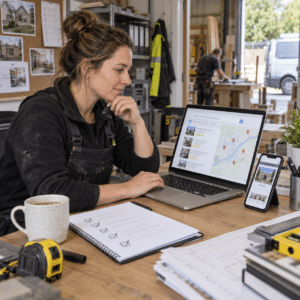
SEO isn’t one trick that suddenly puts your business at the top of Google. It’s the combined effect of getting lots of things right.
Your website content, Google Business Profile, customer reviews, links from reputable websites, technical performance and consistent business information all help search engines understand your business.
And the customer journey isn’t always:
Google → Website → Enquiry
As an example, a potential customer might find you on Google Maps, read your reviews and visit your website, then return a few days later to get in touch. Others might hear about you through word of mouth and Google your business to see if they can trust you.
So, it’s helpful to think of your website, Google Business Profile and reviews as ‘connected parts of the same customer journey’ Rather than separate marketing activities.
Choosing the Right SEO Keywords
Focus on searches that show what your customers want. Someone searching “what is lime plastering?” may still be researching, while “Plasterers near me”, or “Lime Plastering in Hartlepool” shows stronger intent to enquire.
That means we need to to use the words your customers use (known as ‘Search terms’), the problems they want to solve and the locations they search for to shape your website content. So, creating guides and FAQs for people researching their options, while adding strong service and location pages for those ready to take the next step, will ultimately give you the best online visibility for your business.
Your Guild of Master Craftsmen SEO Checklist
You don’t need to become an SEO expert to make meaningful improvements. Which is why we have created this SEO guide for you to reference.
Start by Googling your business and looking at your online presence as if you were a potential customer.
Ask yourself:
- Can I find my business when searching for my main services?
- Is my Google Business Profile complete and accurate?
- Is it obvious where my business operates?
- Do I have recent customer reviews?
- Does my website clearly explain my products and services?
- Does the website work well on a phone?
- Can visitors quickly find a telephone number or enquiry option?
- Do important services have their own useful pages?
Every “no” gives you something practical to work on.
The Final Lesson from This SEO Guide
SEO doesn’t have to mean obsessing over algorithms or trying to understand every Google update.
For GMC members, a much better place to start is the customer journey.
Search → Discover → Check → Trust → Visit → Contact.
At each stage, ask whether your business is visible and whether the information a customer finds gives them a reason to continue.
Remember:
- Your Google presence gets you discovered
- Your Business Profile helps customers understand who and where you are
- Reviews build confidence
- Your website provides the detail
- And good SEO connects everything together.
So instead of asking only “Do we have a website?”, ask a more useful question:
“When someone searches for what we do, can they find us? And does everything they find give them confidence to take the next step?”
Get that right, and you’ll have built the foundations of a much stronger online presence.
Contact us for a Handy SEO Guide Delivered Straight to Your Inbox.
The Digital Department and The Guild of Master Craftsmen are working in partnership to help members improve their visibility online and reach more customers. This handy SEO guide is the second in a series called ‘Crafting your Digital Presence – Traditional Skills, Modern Visibility’. You can find the first blog in the series here.
Get in touch with either The Digital Department, or your contact at GMC to find out how we can support your business and help you take the next step.
Want the full SEO Guide delivered to your email inbox? Simply click here, fill out the form at the bottom of the page and we’ll get the full guide over to you!